For Pool Builders, Service Companies & Landscape Contractors
Reading time: 5-7 minutes
TLDR
The Problem: Most contractors post on their Google Business Profile and see no ranking impact. The posts look fine. They just don’t move the needle.
Why: Google Posts aren’t a primary ranking signal on their own. But the way you write them, and whether they reinforce the right signals, makes a real difference over time.
What works: Posts that echo your primary category, name real service types and cities, include a clear call to action, and stay on a consistent schedule.
Bottom line: Fix your GBP foundation first (categories, citations, reviews). Then post with intention. Posts on a cracked foundation don’t rank, they just keep you busy.
Most pool and landscape contractors who ask me about GBP posts start the same way: “I post every week. Why am I still not showing up in the Map Pack?”
It’s a fair question, and the answer has two parts.
First: posts alone don’t control your Map Pack ranking. Google’s local algorithm is driven by category alignment, proximity, review signals, and citation consistency. If those foundations are weak, no amount of posting will compensate.
Second: once your foundation is solid, how you write your posts does matter. Not because Google reads them the way a person does, but because well-structured posts reinforce the signals Google is already looking for.
This article covers both. If you’re not sure whether your GBP foundation is solid, start with Why Your Pool Company Isn’t Showing Up in the Google Map Pack before reading this one. If you’ve already done that work, keep going.
What Google Posts Actually Do (and Don’t Do)
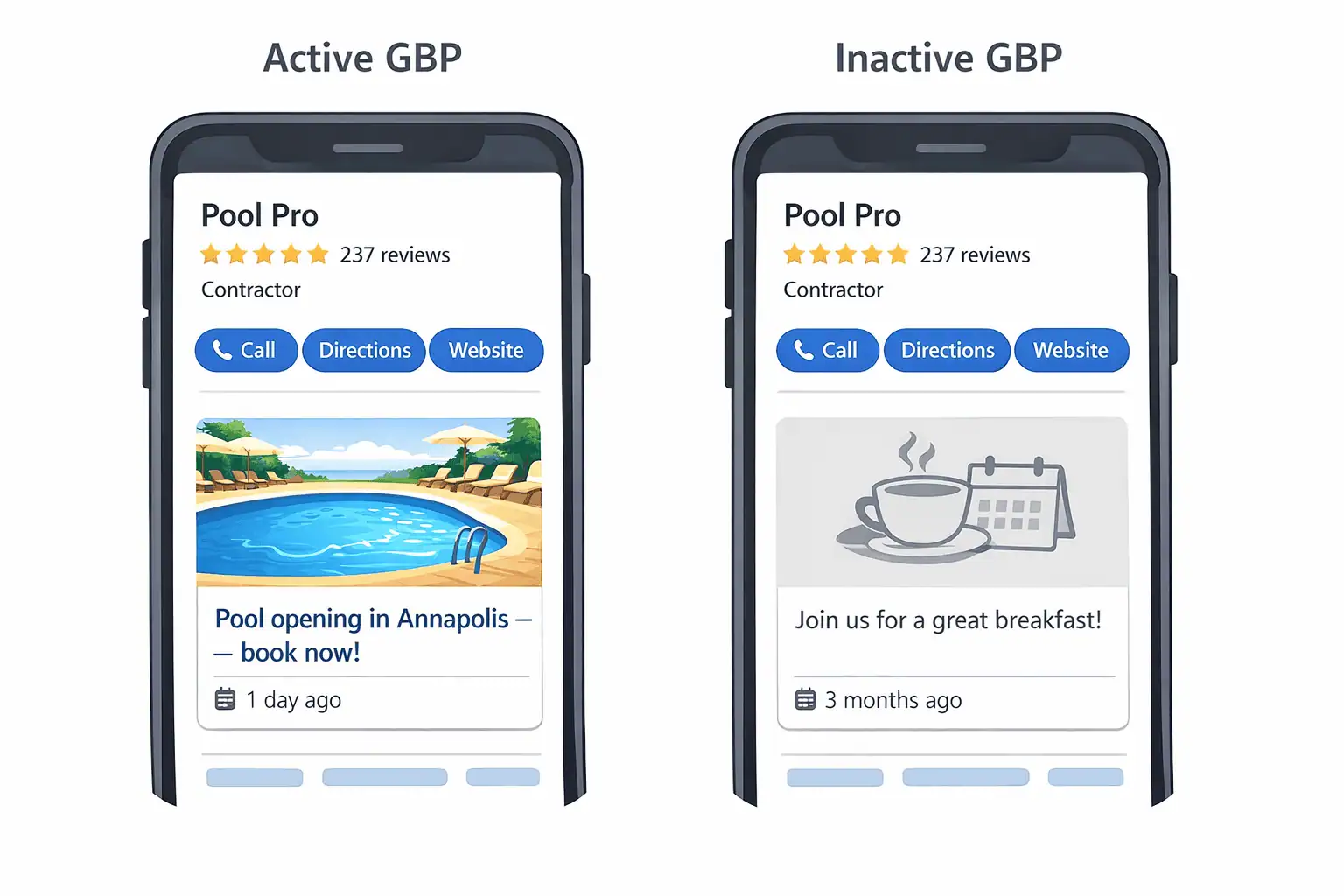
Let’s be direct about something a lot of SEO content glosses over: Google Posts are not a strong direct ranking signal.
Google has said as much, and the data backs it up. Businesses with optimized categories, strong review velocity, and clean citations consistently outrank businesses that post frequently but have weaker fundamentals.
So why post at all?
💡 KEY TAKEAWAY: posts support your ranking system, they don’t replace it.
The Foundation Has to Come First
Before we get into how to write better posts, this point is worth saying plainly: if your GBP categories are wrong, your service areas are vague, or your reviews have gone quiet, fixing those issues will do more for your Map Pack visibility than any posting strategy
A common pattern we see in audits: a contractor posts consistently, the profile looks active, but the primary category is “General Contractor” instead of “Pool Contractor.” Google doesn’t know what they do. All those posts about pool openings and equipment repairs are landing on a profile that Google doesn’t confidently associate with pool services.
Fix the structure first. Then make the posts work harder.
What Makes a GBP Post Actually Work
Once your foundation is solid, the goal of every post is simple: add another clear, consistent signal that tells Google, and the people searching, exactly what you do and where you do it.
Four elements make that happen.
1. Service specificity
Generic posts waste the signal. “We love helping homeowners enjoy their outdoor spaces” tells Google nothing it doesn’t already know (or can’t verify). Instead, name the actual service.
| Weak | Stronger |
|---|---|
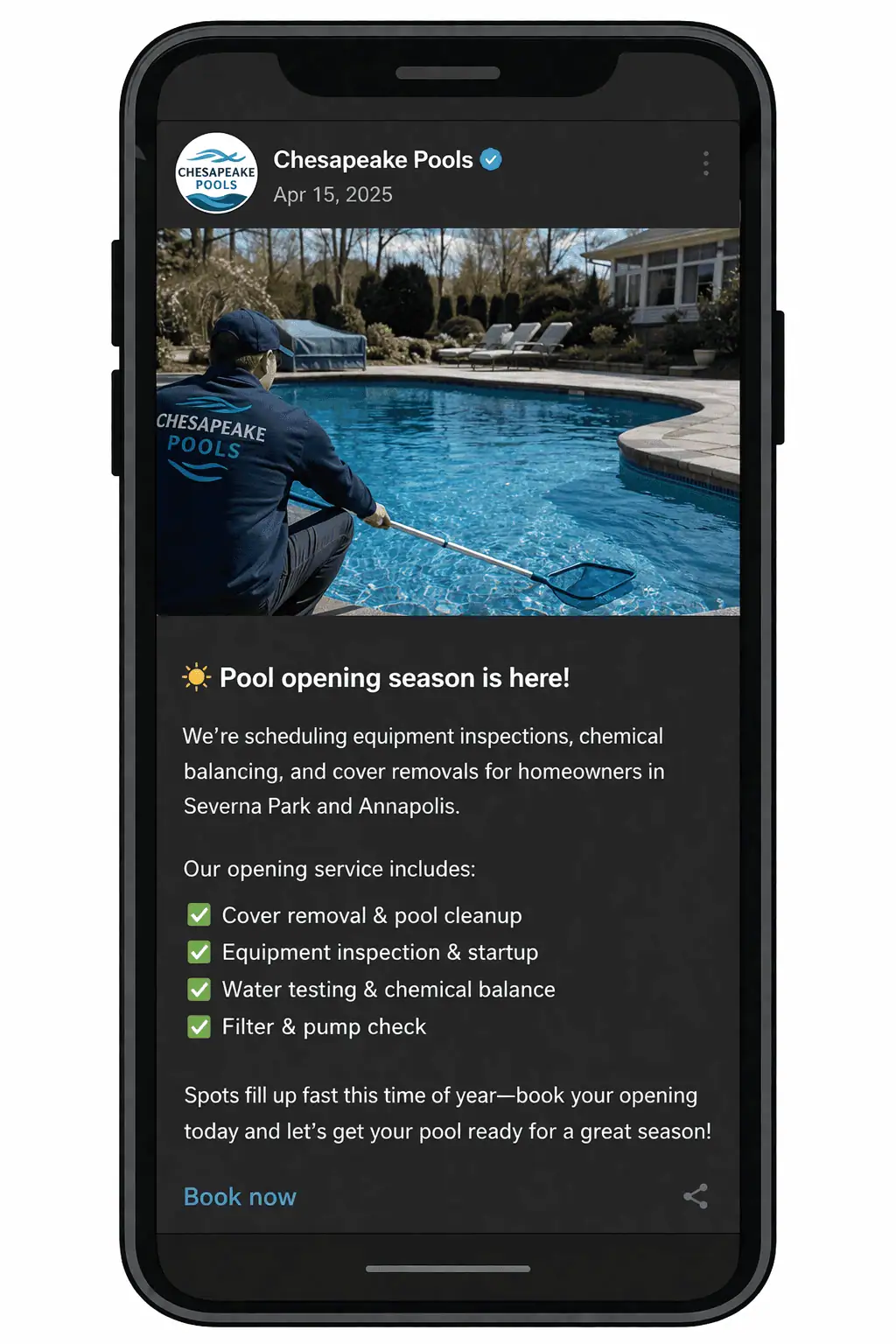
| Spring is here, time to enjoy your pool. | Pool opening season is here. We’re scheduling equipment inspections, chemical balancing, and cover removals for homeowners in Severna Park and Arnold. |
| We build beautiful outdoor living spaces. | Just finished a custom pool and patio build in Annapolis with gunite shell, travertine coping, and integrated lighting. Accepting consultations for spring builds now. |
2. Geographic grounding
Your service area setting tells Google where you work. Your posts can reinforce that signal by naming real places, cities, neighborhoods, and counties where your jobs actually happen.
This doesn’t mean keyword-stuffing city names. It means writing the way you’d describe a job to a neighbor: “We just wrapped a hardscape project in Broadneck” is natural, useful, and signals local relevance without reading like an SEO experiment.
A useful practice: when you finish a project, write a quick post about it before you leave the job site. Location is fresh, details are accurate, and the timing of fresh content is a small positive signal in itself.
3. A clear next step
Every post should tell the reader what to do next. Google Posts support several call-to-action button types: Book, Call, Learn More, Get Offer, and Sign Up. Use the one that matches what you actually want the reader to do.
For most pool and landscape contractors, “Call Now” or “Book” tied to a scheduling link performs best. The goal isn’t just engagement, it’s a booked call.
One note: make sure the page you’re linking to is ready to convert. A post that drives traffic to a slow, generic homepage loses the lead. Link to a landing page that speaks to the specific service or season.
4. Consistency over frequency
Posting daily for two weeks and then going quiet for a month is worse than posting once a week, every week. Google interprets inconsistency as instability. One solid post per week, written with intention, beats five rushed posts any day.
Google Posts have a short visible lifespan; most are displayed for about 7 days before they're archived. That means your posting cadence directly determines how much of the time your profile looks active and current.
Four Post Types Worth Rotating
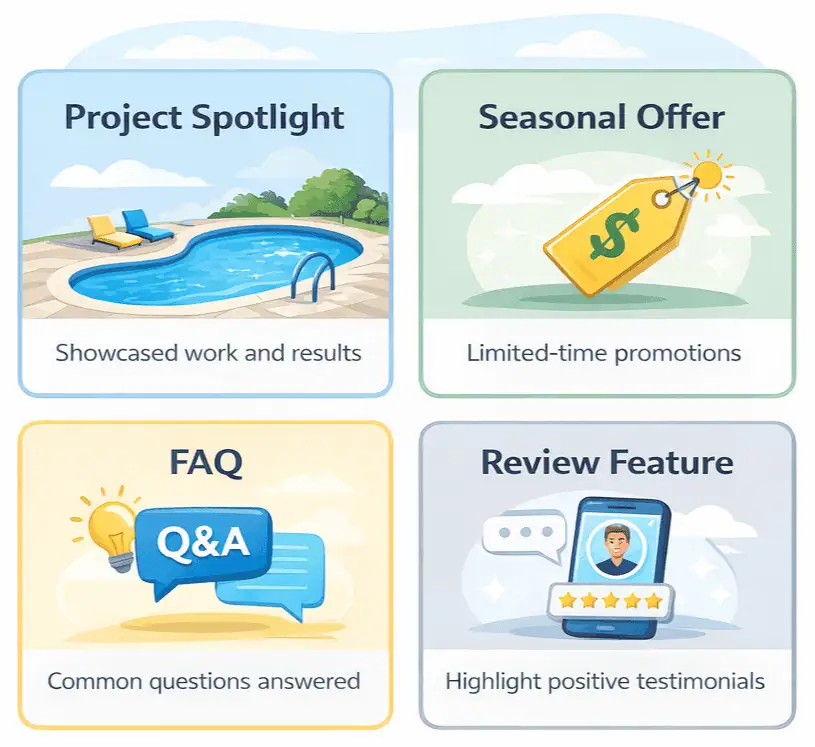
Variety keeps your profile fresh and gives you something useful to say each week. These four types cover the main reasons contractors post, and each one pulls a different kind of signal.
Project spotlight
Brief recap of a completed job: what was done, where, and what the client now has. Include a photo. Name the service type and city. This is your most versatile post type and works year-round.
Example structure:
Just wrapped a pool renovation in [City], resurfaced the shell, replaced the aging pump system, and added LED lighting throughout. The homeowners had been putting this off for two seasons. Now it’s done right. If your equipment is more than 8 years old, it’s worth a look before summer. Call us or book a quick assessment.
Seasonal offer or promotion
Time-bound offers perform well because they create a reason to act now. Tie them to your actual season: pool openings in March/April, equipment tune-ups before peak season, winterizations in September/October.
Keep the offer simple and the urgency honest. “Book a pool opening this month and we’ll waive the chemical analysis fee” is concrete and easy to act on.
FAQ or common question
Answer one question your clients actually ask. These posts earn engagement because they’re genuinely useful, and they position you as the expert before anyone has even called.
Good examples for pool and outdoor living contractors:
- How early should I schedule my pool opening?
- What’s the difference between resurfacing and replastering?
- How long does a hardscape project typically take?
Review feature
Pull a recent review and let it speak. Add a short line of context, what the project was, where it was, then thank the client by first name. This type of post does triple duty: it shows social proof, reinforces your service and location signals, and demonstrates that you’re engaged with your customers.
Real Example
Ashwood Property Care, a full-service outdoor living company in New Milford, CT, ranked at the top of local search during a major winter storm and picked up new plowing accounts as a result. Owner Peter reached out mid-season, not with a question, but to say thank you. That's what consistent GBP management looks like in practice.
A Simple 4-Week Rotation
This is a starting point, not a rigid formula. Adjust based on your season and what’s actually happening in your business.
| Week | Post Type | What to Include |
|---|---|---|
| Week 1 | Project spotlight | Service type, city, brief outcome, photo, CTA |
| Week 2 | Seasonal offer | Specific service, timeframe, simple action step |
| Week 3 | FAQ | One real client question, clear answer, soft CTA |
| Week 4 | Review feature | Client name, service, city, your context line |
What Doesn’t Work (Save Your Time)
A few patterns that look like a posting strategy but don’t help:
- Posting without a CTA. A post that ends “We’re here for all your pool needs!” is a dead end. Every post should have somewhere specific for the reader to go.
- Recycling the same post. If your last 8 posts are variations of “Call us for a free estimate,” Google and your readers both notice. Rotate the content.
- Using stock photos. Your own project photos perform better. They’re authentic, location-relevant, and they differentiate your profile from every competitor using the same licensed image.
- Posting without fixing the foundations first. This one bears repeating. If your primary category is wrong, you can post every day, and Google still won’t confidently surface you for the searches that matter.
What to Do Next
If you haven’t audited your GBP foundation yet, categories, service areas, review velocity, citation consistency, start there. Posting on a weak foundation is a reliable way to stay busy without making progress.
Our Map Pack audit identifies your specific structural constraint in 20 minutes. We look at categories, profile completeness, review momentum, and website local relevance, and tell you exactly what to fix first.
If your foundation is solid and you’re ready to build a consistent posting system, the 4-week rotation above is a practical place to start.
Related Articles
See the full overview: Why Your Pool Company Isn’t Showing Up in the Google Map Pack (And How to Fix It) → The comprehensive pillar article covering everything
Frequently Asked Questions (FAQ)
How long should a GBP post be?
Google allows up to 1,500 characters, but most effective posts run 100–300 words. Long enough to be specific, short enough to be read. Lead with the most important information. Google truncates previews around 100 characters, so don’t bury the lead.
Do GBP posts expire?
Standard posts (What’s New, Offers, Events) stay visible for 7 days before they’re archived. They don’t disappear from your profile entirely, but they’re no longer prominently shown. That’s why weekly posting matters: you want your most recent post to always be current.
Should I use hashtags in GBP posts?
No. Hashtags serve no purpose in Google Business Profile and can make your posts look less professional. Focus instead on clear language, service specificity, and geographic context.
Will posting help if I’m already ranking well?
Yes, maintaining activity signals to Google that your business is active and up to date. It’s also a direct conversion opportunity. A prospect comparing two highly-ranked profiles will often call the one that looks more active and specific.
How much time does this actually take?
One post per week takes about 10–15 minutes if you have a photo ready and know what you want to say. Batching four posts at once, spending an hour on the first of the month, is a practical approach for busy contractors. The 4-week rotation above is designed to make that easier.
Not sure if your GBP foundation is holding you back?
We’ll audit your categories, profile completeness, review velocity, and website local relevance, and identify your specific Map Pack constraint in 20 minutes.

About the Author
Pam Haskell is the founder of Pool & Patio Digital, a marketing agency dedicated to helping pool builders and landscape professionals win more local leads online. With over a decade of experience in outdoor living and digital strategy, Pam is a member of the Pool & Hot Tub Alliance (PHTA) and writes regularly on local SEO for service businesses.
Connect on LinkedIn | Read Featured Articles in Top Industry Publications