
For Pool Builders, Service Companies & Landscape Contractors
Reading time: 6-8 minutes
TLDR
The noise: AI is either going to transform your business overnight or put your whole team out of work. Neither is accurate.
The reality: AI is a capable assistant for specific, repeatable tasks. It’s not a strategist, a relationship-builder, or a replacement for local market knowledge.
What it’s good for: Content drafts, lead follow-up sequences, after-hours chat capture, GBP post creation, and review request automation.
What it still needs you for: Strategy, local context, client relationships, quality review, and any judgment call that depends on knowing your market.
Bottom line: The contractors getting value from AI right now are using it to do more with the same team, not to replace the team. Start with one use case, get comfortable, then expand.
You’ve probably heard it from every direction by now. AI is going to change everything. Or AI is just hype. Or your competitor is already using it, and you’re falling behind.
Most of that noise isn’t aimed at you. It’s aimed at investors, tech journalists, and people who run software companies.
This article is aimed at pool builders, pool service companies, and landscape contractors who want a straight answer: what does AI actually do that’s useful for a local service business right now, and where does it still fall short?
No hype in either direction. Just a practical read.
Why Contractors Are Confused About AI (And That’s Understandable)
The confusion is reasonable. AI tools have improved faster than most people’s ability to evaluate them, and the marketing around them tends toward extremes.
On one end: “AI will run your entire business while you sleep.” On the other: “AI content is garbage and Google will penalize you for using it.” Both are overstated.
The more useful question is: for a pool builder or landscape contractor running a local service business, which specific tasks does AI handle well, and which ones still need a person? That’s what this article answers.
A note on scope
This article covers AI in a marketing and operations context: content creation, lead follow-up, customer communication, and local visibility. It doesn’t cover AI in estimating software, job management platforms, or field service tools, those are separate categories with their own learning curve.
What AI Actually Is in a Business Context
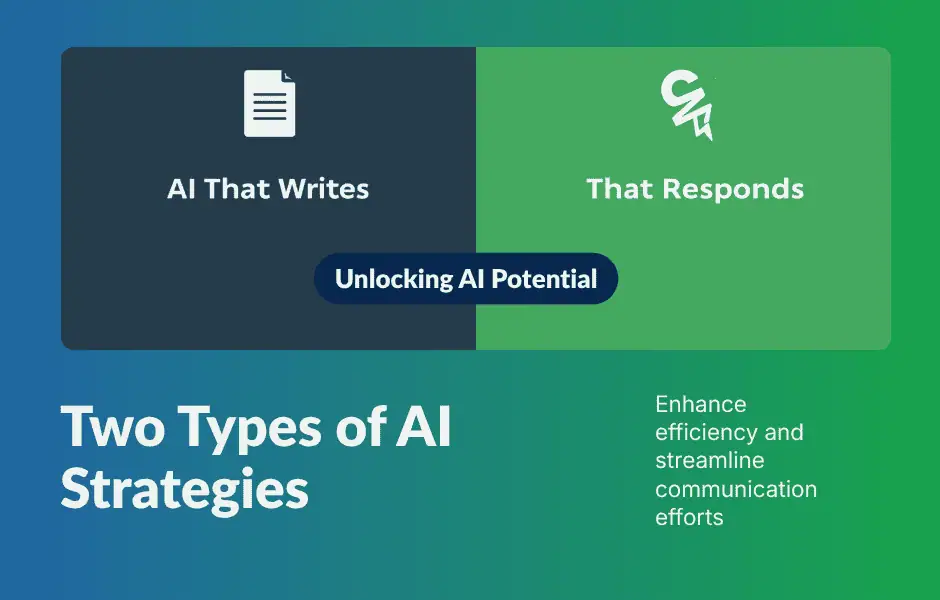
For most contractors, “AI” in a business tool means one of two things:
These two things are often bundled together in the same platform, which is why the category feels blurry.
A missed-call textback system is “AI-powered” in the sense that it uses smart routing logic. A content tool that writes your GBP post is AI in the sense that it generates language from a prompt. Both are useful. They’re just useful for different reasons.
The common thread: AI handles volume tasks that follow a pattern. The less predictable and more relationship-dependent a task is, the less useful AI becomes.
What AI Can Do Well for Pool and Outdoor Living Contractors
These are the categories where AI is genuinely saving contractors time right now. Not in theory, but in practice.
Content drafting
AI is a capable first-draft writer. Give it a clear prompt: “write a 300-word Google Business Profile post about pool openings for homeowners in Annapolis”, and it produces something usable in seconds.
The key word is first draft. AI doesn’t know your brand voice, your specific market, or your customer base. It produces serviceable copy that needs editing before it sounds like you. But cutting the blank-page problem from 45 minutes to 10 is a real value.
Where this applies: GBP posts, blog outlines, service page drafts, email sequences, social captions, and FAQ sections.
Lead follow-up automation
This is probably the highest-ROI AI application for local contractors right now. When a prospect calls, and you’re on a job site, an AI-powered textback system responds within 60 seconds, keeps them engaged, and offers a booking link before they move on to your competitor.
The same logic applies to form submissions. AI-powered CRM sequences send a confirmation immediately, follow up on day three with a relevant case study, and nudge again on day seven without anyone on your team lifting a finger.
The human element matters here too, these sequences need to be set up thoughtfully and reviewed periodically. But once running, they operate 24/7.
After-hours lead capture
AI chat tools: simple website chatbots configured for your specific services can qualify leads after hours, collect contact information, answer common questions, and route serious inquiries to your inbox.
For pool service companies, especially those where calls often come in on evenings and weekends, this closes a real gap. A prospect who gets an immediate, helpful response at 9 PM is more likely to still be interested when you call back at 8 AM.
Review request automation
Asking for reviews manually is one of those tasks that gets dropped when you’re busy, which is exactly when you’re finishing the most jobs and have the most opportunity. AI-powered review systems send a request automatically when a job is marked complete in your CRM, without requiring anyone to remember.
The message still needs to sound human (more on that below), but the timing and consistency are handled automatically.
Local SEO content at scale
If you serve multiple cities, AI can help produce location-specific content, including service pages, GBP posts, and FAQ sections, faster than writing each one from scratch. A page for “pool opening services in Arnold, MD” and a page for “pool opening services in Severna Park, MD” have a lot in common structurally, and AI handles the repeatable portions well.
The local details, such as specific neighborhoods, landmarks, seasonal patterns, and community references, still need a human touch. But the structural work is accelerated.
What AI Still Can’t Do
This is the part that tends to get skipped in AI marketing content. It matters for setting realistic expectations.
Understand your local market
AI doesn’t know that your market skews toward custom builds over service contracts, or that your best clients come from one particular subdivision, or that a competitor just closed and there’s an opening. It works from general patterns. Local market intelligence is yours.
Build or manage client relationships
A long-term pool service client who’s been with you for eight years has a relationship with you, not with your automation platform. Retention, referrals, and upsells run on trust and familiarity. AI can support the communication cadence; it can’t replicate the relationship.
Make strategic decisions
Should you expand into hardscape? Is it the right time to raise prices? Which service line is worth investing in next season? AI can help you gather information and structure the question, but the decision requires judgment, risk tolerance, and knowledge of your own operation that no tool has access to.
Produce content that’s consistently on-brand without oversight
AI writing tools produce plausible copy, not distinctive copy. Left unsupervised, the output tends toward generic phrasing, safe takes, and a flat tone that reads like every other contractor’s website. Your voice: specific, confident, grounded in real experience, requires a human editor in the loop.
Replace judgment on sensitive situations
A negative review that needs a careful response. A client dispute. A prospect who seems frustrated. These situations require reading between the lines, and AI doesn’t do that reliably. Use a template as a starting point if you need to, but write the final message yourself
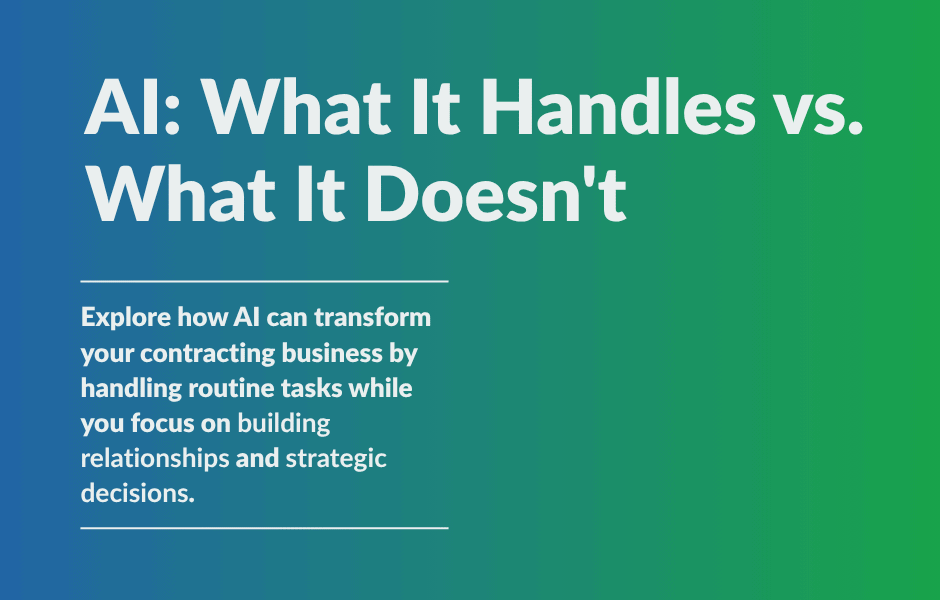
| ✔ AI can do this | ✘ AI can't do this (yet) |
|---|---|
| Draft content in seconds (posts, emails, pages) | Decide what strategy to pursue |
| Respond to missed calls instantly, 24/7 | Build or maintain client relationships |
| Send follow-up sequences on a consistent schedule | Understand your specific local market |
| Capture and qualify leads after hours | Produce consistently on-brand copy without editing |
| Request reviews automatically after job completion | Handle sensitive customer situations |
| Generate location-specific page drafts at scale | Replace strategic thinking or business judgment |
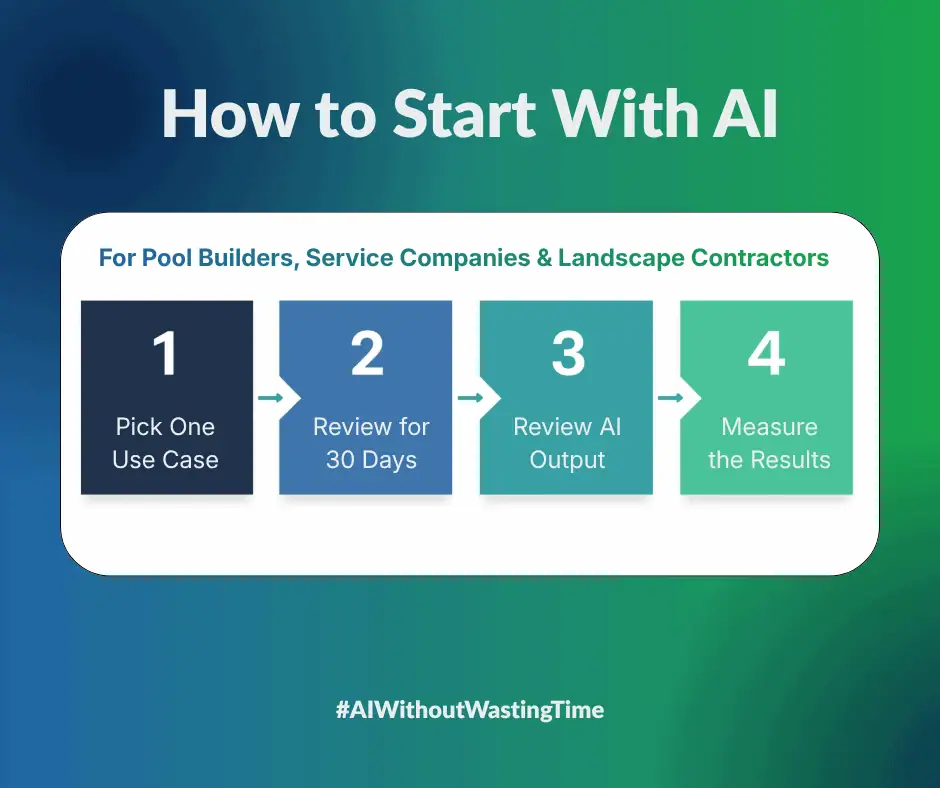
How to Start Without Wasting Time or Money
The most common mistake contractors make with AI is trying to implement too many things at once. They sign up for three platforms, spend two weeks setting things up, get inconsistent results, and conclude that AI “doesn’t work.”
A more reliable approach:
Not sure which AI application fits your stage?
Our Growth Audit identifies your highest-leverage opportunity based on where your business is right now, whether that’s lead capture, content, reviews, or something else entirely.
Frequently Asked Questions (FAQ)
Do I need technical skills to use AI tools as a contractor?
No. Most AI tools built for small businesses use plain-language prompts, you type what you want, and review what comes back. The learning curve is usually a few hours, not weeks.
Will AI replace my marketing team or agency?
Not the good ones. AI handles volume tasks: drafting, scheduling, formatting, and initial follow-up. Strategy, local market knowledge, relationship-building, and judgment calls still need a human. AI makes a capable team faster, it doesn’t replace the team.
What AI tools are most useful for pool and landscape contractors right now?
The highest-value applications are: AI-assisted content drafting for blogs and service pages, automated lead follow-up sequences inside a CRM, AI chatbots for after-hours lead capture, and AI tools for GBP post creation. Start with one and get comfortable before adding more.
How do I know if AI-generated content is hurting my SEO?
Google doesn’t penalize AI-generated content by default, it penalizes low-quality, unhelpful content regardless of how it was produced. The risk is publishing AI drafts without editing: generic phrasing, missing local context, and no original perspective. Review everything before it goes live.
Is AI worth the investment for a business under $500K?
Yes, selectively. At that stage, the highest-ROI AI tools are free or low-cost: AI writing assistants for content drafts, basic chatbot lead capture, and automated review requests. You don’t need an enterprise AI stack. Start simple, measure results, and layer in more as revenue grows.
What to Do Next
AI is a practical tool, not a transformation event. The contractors getting the most out of it right now are using it to close specific, identifiable gaps, slow follow-up, inconsistent content, and missed after-hours leads, rather than trying to automate everything at once.
If you’re not sure which gap to close first, that’s exactly what a Growth Audit is for. We look at your current systems, identify where leads and revenue are slipping through, and recommend the highest-leverage starting point.
If you’re already running automations and want to go deeper, the next article in this series covers how contractors are using AI specifically to speed up lead follow-up without sounding like a robot.
Want to know where AI would make the biggest difference in your business?
The Growth Audit looks at your current setup: leads, follow-up, content, reviews, and tells you exactly where the gaps are and what to fix first.
Ready to implement these AI systems in your business?
Pepper Studio Pro is the all-in-one marketing platform built for service contractors. It includes the missed-call textback, CRM, review automation, email and SMS sequences, and webchat tools described in this article, all in one place, no duct-taped software stack required.
Used inside every Pool & Patio Digital Growth program. Available directly at $497/month with no contract.

About the Author
Pam Haskell is the founder of Pool & Patio Digital, a marketing agency dedicated to helping pool builders and landscape professionals win more local leads online. With over a decade of experience in outdoor living and digital strategy, Pam is a member of the Pool & Hot Tub Alliance (PHTA) and writes regularly on local SEO for service businesses.
Connect on LinkedIn | Read Featured Articles in Top Industry Publications
