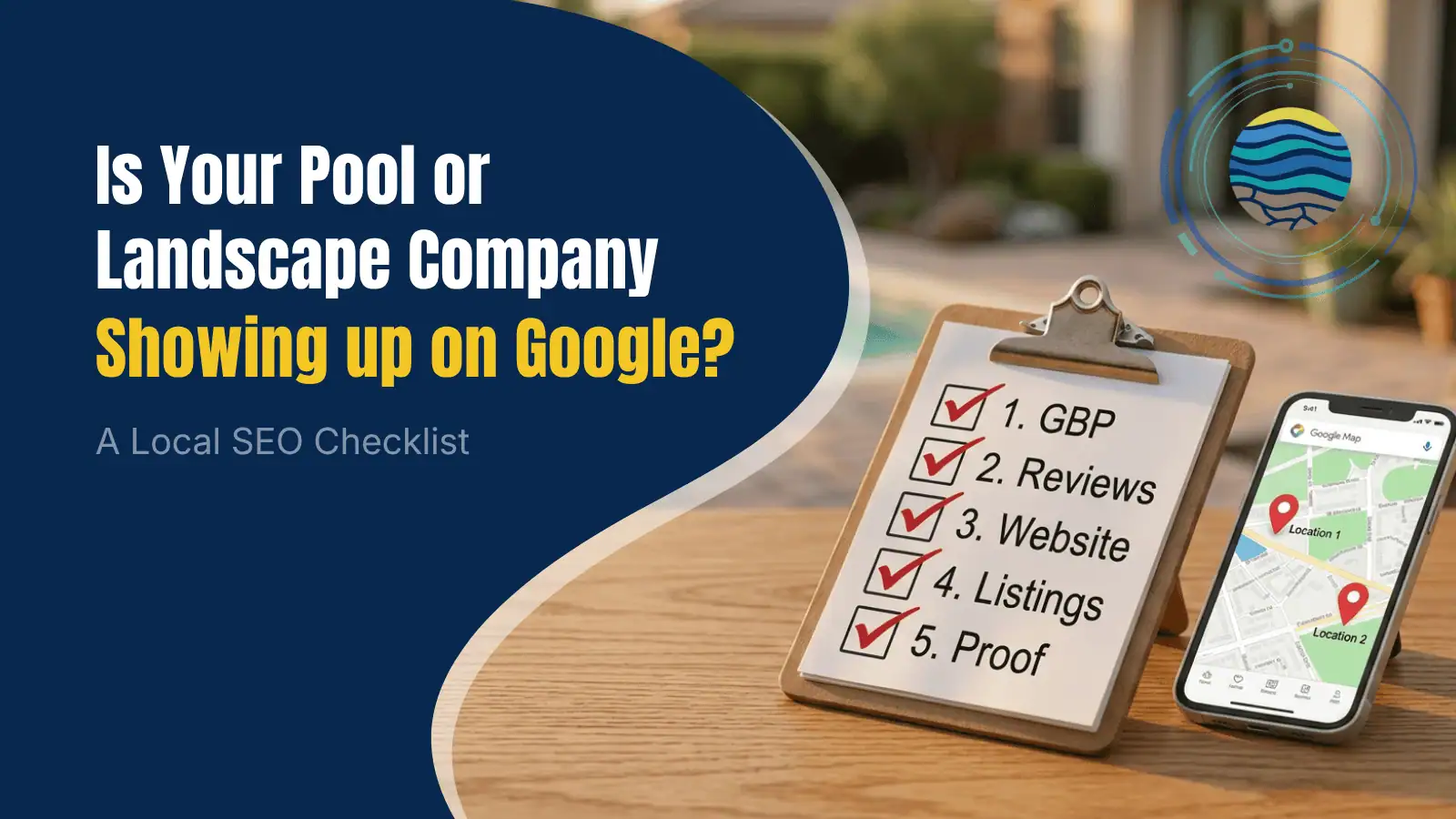
A practical, no-fluff checklist for pool builders, pool service companies, pool stores, and landscapers who want to show up when local customers search.
Reading time: 8-9 minutes
Most pool and outdoor living companies don't have a marketing problem. They have a visibility problem.
You do good work. Your crews stay busy through referrals. But when a homeowner three miles away searches "pool builder near me" or "landscaper open now," you're either on that first screen of results, or you're invisible. There is no middle.
Here's the direct answer to the question in the title: you show up on Google by getting a handful of specific things right, in order. A complete Google Business Profile. A steady flow of recent reviews. A website with a real page for each service you offer. Consistent business information everywhere your company is listed. That's it. Not magic, not a secret algorithm trick. A checklist.
This post is that checklist. Work through it in order. Most companies can knock out the first section in an afternoon.
Key Takeaways
- Nearly half of all Google searches have local intent, and 76% of people who search for something nearby visit a business within 24 hours.
- Your Google Business Profile is the highest-return fix on this list. Complete profiles make customers 70% more likely to visit, according to Google's own data.
- Reviews are not optional. 97% of consumers read them before choosing a local business.
- A separate page for each service you offer beats one crowded "Services" page every time.
- You don't need to do everything. You need to do the first ten items before your competitor does.
You’ve probably heard it from every direction by now. AI is going to change everything. Or AI is just hype. Or your competitor is already using it, and you’re falling behind.
Most of that noise isn’t aimed at you. It’s aimed at investors, tech journalists, and people who run software companies.
This article is aimed at pool builders, pool service companies, and landscape contractors who want a straight answer: what does AI actually do that’s useful for a local service business right now, and where does it still fall short?
No hype in either direction. Just a practical read.
Why Does Local Search Matter So Much for Outdoor Living Companies?
Because your customers are, by definition, local. Nobody hires a pool builder two states away.
The numbers back this up. Google has said that 46% of all searches have local intent. And 76% of people who search for something nearby on their phone visit a business within 24 hours. These aren't people browsing. These are homeowners with a project and a budget, deciding who to call this week.
Here's the part that stings: the businesses in the top three map results get 126% more traffic than everyone below them, according to research from SOCi. Showing up fourth is close to not showing up at all.
One more shift worth knowing. BrightLocal's 2026 consumer survey found that 45% of consumers now use AI tools like ChatGPT to get local business recommendations, up from 6% just a year earlier. Those AI tools pull from the same signals on this checklist: your profile, your reviews, and your service pages. The work below covers you in both places.
You're busy running jobs, managing crews, and handling estimates. Marketing gets pushed to the bottom of the list. That's normal. This checklist exists so that when you do sit down to work on it, you fix the right things first.
Part 1: Your Google Business Profile
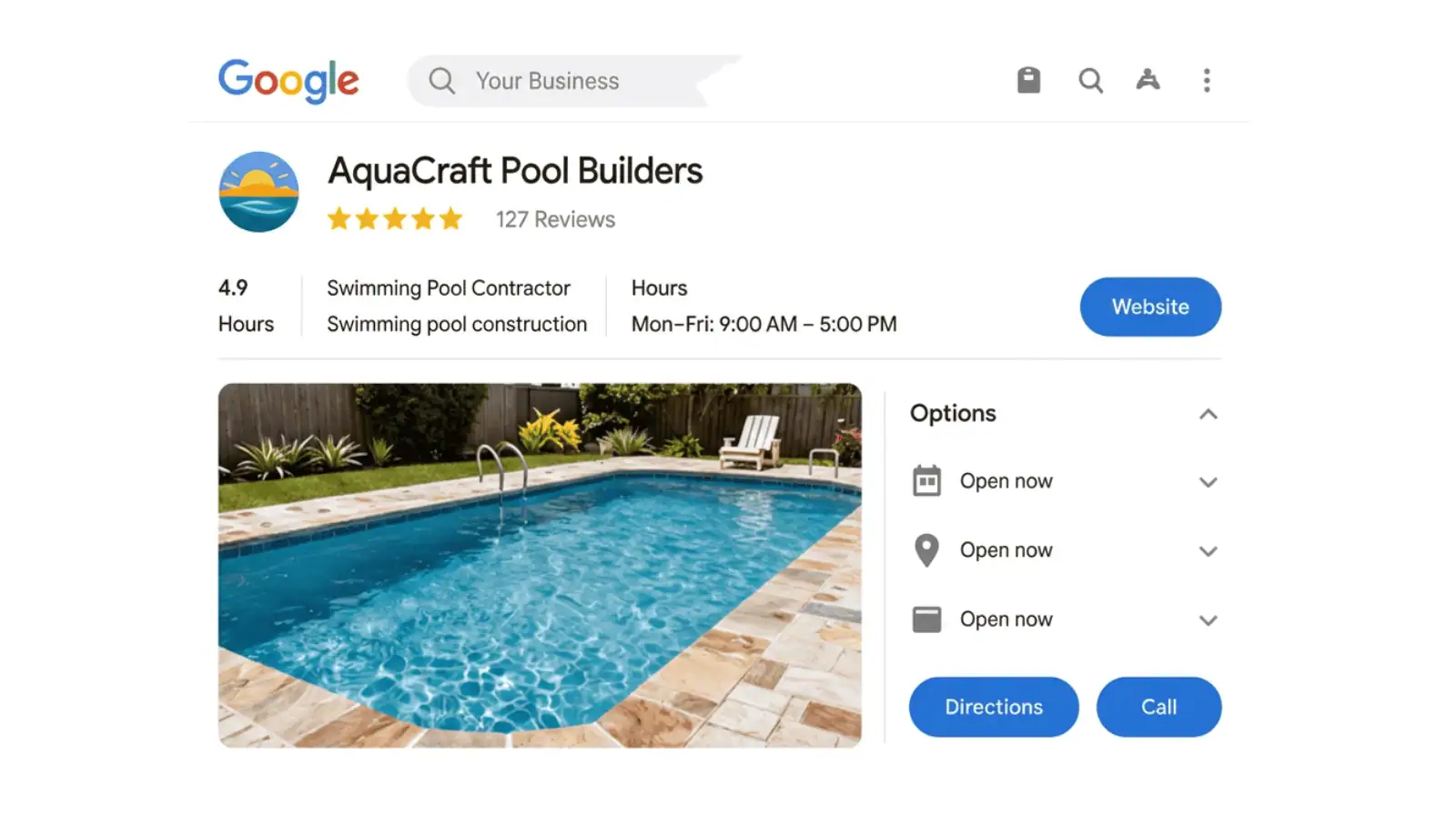
This is the foundation. Google's own data says customers are 2.7 times more likely to consider a business reputable when they find a complete profile, and 70% more likely to visit. Start here.
☐ 1. Claim and verify your profile. If you haven't claimed your Google Business Profile, nothing else on this list matters yet. Search your business name, look for the "Own this business?" link, and complete verification.
☐ 2. Set your primary category correctly."Swimming Pool Contractor," "Pool Cleaning Service," "Swimming Pool Supply Store," "Landscaper." Your primary category is one of the strongest ranking signals you control. Pick the one that matches your main revenue source, then add secondary categories for everything else you do.
☐ 3. List every service, with descriptions. Pool openings, closings, weekly service, renovations, paver patios, retaining walls. Each service you list is another way to match a search.
☐ 4. Add real photos, and keep adding them. Finished projects, crews at work, your trucks, your storefront, if you have one. Skip the stock photos. Homeowners want to see your actual work in yards that look like theirs.
☐ 5. Confirm your hours, phone number, and service area. Wrong hours cost you calls. If you're a service-area business without a storefront, set that correctly instead of showing an address.
☐ 6. Post to your profile weekly.Project photos, seasonal reminders, service announcements. Google only keeps a post front and center for about a week, so a weekly rhythm means there's always something fresh when a homeowner looks you up. It doesn't need to be clever. It needs to show Google and homeowners that the business is active. If weekly isn't realistic during peak season, twice a month is the floor.
Part 2: Your Reviews
97% of consumers read reviews before choosing a local business, per BrightLocal. For seasonal businesses like yours, reviews also carry you through the slow months. They keep working while you're closed.
☐ 7. Ask every satisfied customer for a review. Not some. Every one. The best time to ask is right after the job wraps, when the yard looks great and the customer is happy.
☐ 8. Make it a system, not a memory test. "I know I should ask for reviews, but we forget" is the most common thing I hear from contractors. If asking depends on someone remembering, it won't happen during the busy season, which is exactly when you're finishing your best work. Put the ask into your job-close process: a text or email with a direct link, sent the same day.
☐ 9. Respond to every review, good and bad. A short, professional response to a negative review often does more for trust than ten five-star ratings. Future customers read how you handle problems.
☐ 10. Aim for recency, not just quantity. A profile with 40 reviews, where the newest is two years old, reads as a business that stopped trying. A steady trickle beats an old pile.
Part 3: Your Website
Your Google Business Profile gets you found. Your website closes the job. Both have to work.
☐ 11. Build a separate page for each core service. One page for pool openings. One for weekly maintenance. One for renovations. One for paver patios. A single "Services" page listing everything can't rank for anything. A dedicated page can rank for exactly what it covers.
☐ 12. Build a page for each town or area you serve. If you serve six towns, a homeowner in each one is searching with their town's name attached. Location pages give Google a reason to show you for those searches. Add a Google Map to each one.
☐ 13. Match your name, address, and phone number to your Google profile exactly. Same spelling, same format. Inconsistency makes Google trust your information less.
☐ 14. Make sure the site works on a phone. Most local searches happen on mobile, often from a backyard mid-project. If your site is slow or the phone number isn't tappable, you're handing that call to the next result.
☐ 15. Answer real questions on your site. "When should I close my pool?" "How much does a paver patio cost?" The questions customers ask you on estimates are the questions they ask Google first. Answer them plainly and you show up for those searches. This matters more every year as AI tools pull answers directly from pages like these.
Part 4: Your Listings Everywhere Else
☐ 16. Check your information on the directories that matter. Yelp, Angi, Houzz, the BBB, your local chamber, and industry directories like the PHTA member listing. You don't need hundreds of citations. You need the main ones to be accurate and identical.
☐ 17. Clean up duplicates and old addresses. Moved shops three years ago? An old listing with your old address is quietly working against you. Find them and fix them or shut them down.
Part 5: Proof It's Working
☐ 18. Check your Google Business Profile insights monthly. Google shows you how many people found you, called you, and asked for directions. Five minutes a month tells you whether any of this effort is moving.
☐ 19. Ask every new lead one question: "How did you find us?" Simple, free, and it tells you more than most dashboards. Track the answers.
☐ 20. Give it 90 days before you judge. Local SEO compounds. Profile fixes can show results in weeks. New service and location pages take a few months to earn their place. If someone promises you page one in a week, that's a red flag, not a shortcut.
What Should You Do First?
If the full list feels like too much for this week, do these three things:
- Complete your Google Business Profile top to bottom (items 1 through 6).
- Set up a same-day review ask for every finished job (items 7 and 8).
- Pick your single most profitable service and build it a dedicated page (item 11).
Those three moves cover the majority of what determines whether you show up. The rest of the checklist strengthens the foundation, but these three pour it.
Frequently Asked Questions (FAQ)
How long does local SEO take to work for a pool or landscaping company? Profile and review fixes often show movement within 30 to 60 days. New service pages and location pages typically take three to six months to rank. Local SEO compounds over time, which is why starting before your busy season, not during it, pays off.
Do I need to hire someone, or can I do this checklist myself? Most of Part 1 and Part 2 you can do yourself in a few afternoons. Service pages, location pages, and cleanup work take more time and skill. Many contractors handle the profile and reviews in-house and bring in help for the website work.
How many reviews does my company actually need? There's no magic number, but recency and consistency matter more than totals. A profile adding two or three genuine reviews a month will outperform a profile with a big pile of old ones. Start with a same-day ask on every completed job.
Is local SEO still worth it now that people ask AI for recommendations? Yes, and arguably more so. AI tools pull recommendations from the same sources: your Google Business Profile, your reviews, and your service pages. The checklist above is how you show up in both Google results and AI answers.
What's the biggest local SEO mistake pool and landscape companies make? Treating the website as finished. A site built five years ago with one generic services page and no reviews strategy can't compete with a company doing steady, basic upkeep. The winners aren't doing anything exotic. They're doing the fundamentals consistently.
The Bottom Line
None of this is complicated. That's the point.
The pool builders and landscapers winning local search in your market are not smarter than you and they don't have bigger budgets. They claimed their profile, they ask for reviews on every job, and they gave each service its own page. Then they kept at it.
You already know how to do consistent, unglamorous work that pays off. That's what built your business. This is the same thing, applied to Google.
If people can't find you, it doesn't matter how good your work is.

About the Author
Pam Haskell is the founder of Pool & Patio Digital, where she helps pool builders, pool service companies, pool stores, and landscapers show up on Google and book more jobs. With over a decade of experience in outdoor living and digital strategy, her work has been published in AQUA Magazine, Green Industry Pros, Lawn & Landscape, and Total Landscape Care.
Connect on LinkedIn | Read Featured Articles in Top Industry Publications
Keep Learning
- Local SEO for Pool & Outdoor Living Contractors: What Actually Works (And What Doesn't) — the full guide behind this checklist, including what to skip.
- Why Your Pool Company Isn't Showing Up in the Google Map Pack (And How to Fix It) — seven fixable issues, with timelines and costs.
- Google Business Profile for Pool & Landscape Pros: 7 Wins — quick profile fixes that can increase calls within 30 days.
- The Review Engine Framework for Pool & Landscape Contractors — the four-step system behind checklist items 7 through 10.